Apologies for not flagging up my mate Tom Geens and the retrospective/premiere in the London Short Film Festival at the ICA. Not only did Tom manage to finagle getting his new feature film (Liar) programmed (how does that work in a 'short film' festival?) but he went on to win "Best Short Film 2010" with his new short, You're the Stranger Here. It's an ideal film for those who enjoy witnessing outbursts of inexplicable and disturbing violence in surreal and unsettling Ceausescu-ish places (Hammersmith, if I recall).
So, belated congrats... and hopefully Film4 (who part-funded it) will pull their fingers out and get it on TV.
You can see a teaser trailer for You're the Stranger Herehere (hear, hear!) along with clips from Tom's other films at Chicken Factory
Tom's now developing another feature that sounds like it'll have his trademark dark comedy and needling of the middle classes with uncomfortable silences...
On a personal note, Stranger marks my entry to IMDb. After months of workshopping over three continents, Tom felt that I was ready to play (triumphantly, even if I do say so myself) 'Man in the Waiting Room'. It would have been a cough and a spit (if he left in the coughing or the spitting).
Second Run have recently released Márta Mészáros' Diary for My Children (Napló gyermekeimnek, 1982) on DVD. Even better, the rest of the trilogy (Diary for My Loves, 1987 and Diary for My Father and Mother, 1990) will follow, so we'll all be able to ditch the VHS's from the C4 screenings all those years ago!
In the meantime there's a special screening of Diary for My Children at the Renoir Cinema on Sunday 22nd November at 2.15, at which I'll be interviewing the uncredited co-writer, and director in her own right, Éva Pataki.
It's a wonderful, semi-autobiographical film about the teenage Juli, returning to Hungary in 1947, having spent the war exiled to the USSR, where her parents died. It perfectly captures the contradictions of post-war Budapest (as I imagine!): the freedoms of western-type fashion shows and the impositions of the regime; moments of personal joy and grating bureaucratic idiocy, and memories and strange dream sequences set against quotidian banalities. All seen through the eyes of Juli, growing to be a woman, discovering love and developing the cinephilia that will lead her to film school.
Zsuzsa Czinkóczi's fantastically touching performance captures Juli's frustration at the lies, dissembling and surreal paranoias that surround her. She carefully balances the solemn and melancholic retreat into memories of pre-war happiness with the steeling of Juli's resolve to counter what she sees around her. Exactly as Mészáros herself does in the film.
You can read more about the film, on Second Run's website, here
Here's the Renoir cinema page, with details of the event.
It seems a good moment to mention a forthcoming screening of Benya Krik at the Purcell Room on 29 November 2009. Among other things, it's a fascinating view of early 20th-century Jewish life, apparently shot partly on location in Odessa.
Made in 1926, it was directed by Vladimir Vilner, while Isaac Babel based the script on his own short stories The King and How It Was Done in Odessa. The Russian texts and the 'kino-povest' (illustrated, left) are here, and Jeff Glodblum - that's Goldblum - reads The King (in English) here.
But Krik, the leader of a bunch of criminals, is hardly admirable and the film had something to offend everyone.
For starters, Krik's gang seems to be first precursors of, and then profiteers from the Revolution. Even though they're ultimately foiled by the Bolsheviks, the regime, obviously, was not impressed.
Meanwhile, Jewish groups were alarmed that it might inflame anti-Semitism.
The Soviet Union spent 1921-22 struggling economically in the face of what Lenin called "the elemental forces of the petty-bourgeois environment", before initiating a limited return to capitalism, even de-nationalising some enterprises - excluding, of course, the 'commanding heights' of heavy industry, banking etc. This 'New Economic Policy' became increasingly divisive: on one hand it made available luxuries - and even some essentials - that state and collective organisations were so signally failing to provide, but NEP-men were despised as spiv-like semi-gangsters and, plugging into Russian anti-Semitism, were often seen as Jewish.
In such an environment, Krik couldn't do right for doing wrong. Not only did it upset the authorities, but it was accused of ignoring the proletariat and concentrating on Jews (as if they were inimical!). But of course, it 'concentrates' on them only to criticise them as cynical petty thieves who are happy to trash tradition and their Jewishness in the pursuit of profit.
A few months later Babel's astonishing play Sunset opened, in which Krik, fearing disinheritance, beats his father up then arranges an abortion for his gentile girlfriend, and forces his sister into marriage to obtain the dowry. After all this, he is praised by the local rabbi.
Ethnically even more confusing is that Babel based Krik on the well-known Odessa gangster Mishka 'Yaponchik' (Mike the Little Jap) Vinnitsky, though I'm not sure why - he was Jewish and born in Odessa. Allegedly this is a portrait.
He's also the subject of Juliusz Machulski's Polish film Déjà vu (1988), which takes the action to Chicago: I suppose the archetypal US gangster city - it's where Balabanov's Brother II goes. Babel, perhaps seeing that he had created a potentially long-running franchise, didn't kill Krik in the books but he does die in Vilner's film, suffering a fate based on Mishka's death. Maybe Babel felt (or was advised) that the more popular medium needed to show retribution.
Krik is still a popular hero, largely thanks to the panache which Babel gave him - the Russian movie Мишка Япончик (Mishka Yaponchik, 2007) is part of the series Great Russian Adventurers! You can see a silent movie style trailer here.
Vilner's film was released in January 1927 but pleased nobody. It was almost immediately banned in Ukraine and never shown in Moscow. It has since fallen into that huge well of forgotten curiosities. After a couple more films, Vilner returned to the theatre, from when he had come.
Nevertheless Eisenstein recommended the script to Ivor Montagu, whose English translation was published by Collett's in 1935 in a numbered edition of 500. That sold well enough to go to another numbered 500. I've never seen this tome but I suspect it's the 1925 script that Babel wrote with Eisenstein, who later remembered the author observing that "writing a script is like calling the midwife out on your wedding night".
Eisenstein, whilst eating stewed apples, sharing vodkas with Malevich, and corresponding with Stefan Zweig, was dividing his time between Krik, 1905 (aka The Battleship Potemkin) and a wartime front-line brothel comedy called The Bazaar of Lust. In 1932 he praised the 'laconicism' of 'the vastly underestimated play Sunset', though it had been heavily criticised and dropped from the repertoire five years previously. Babel got permission to go to Paris for a year and on his return he and Eisenstein would work on the banned and destroyed Bezhin Meadow. In 1939 he was arrested for being an 'anti-Soviet Trotskyite spy' (recruited during his time in Paris) and 'a member of a terrorist conspiracy'. He was shot in 1940 and dumped in a mass grave.
In case you thought I'd forgotten about it - a heads-up/reminder of Between Two Worlds, the Alfred Schnittke festival led by the LPO and happening at various places in London from 15 November to 1 December to mark what would have been his 75th birthday.
It's hard in the course of such a mini-fest to do justice to the enormity of Schnittke's output (even if you think - as I don't - that it's wildly uneven). Of course there are things I'd want to have seen, primarily the hallucinogenically terrifying First Symphony, and one of the last symphonies, and perhaps a survey of the concerti grossi (and of course, more films!) but over all it's as balanced as it could be in the time available.
15/11. The Gogol Suite and the (brilliant) Monologue followed by Prokofiev 6 at the RAM.
18/11. Royal Festival Hall. A 6.15 pre-concert event with the 3rd SQ (his best?) played by the Harpham Quartet. Then, in the main concert, rather than just doing the Faust Cantata, there are excerpts from the opera that swallowed it (basically as Act 3). These are semi-staged, so perhaps Jurowski is moving towards a very welcome production - in which case, hopefully he'll be conducting what Schnittke wrote rather than the 'Hamburg edition'. It's preceded by Haydn 22 (is the subtitle the only link?) and bits of Parsifal. Here's a bit of Arte's broadcast of Historia von D. Johann Fausten. Would that BBC4...
19/11. Back at the RAM for a visit from the Moscow Conservatory Chamber Choir and a good belt of Russian choral stuff. The Concerto for Choir is another cast-iron masterpiece.
21/11. An all-day symposium at Deptford Town Hall under the aegis of the Alfred Schnittke Archive at Goldsmiths. Even those usually averse to academic conferences might be tempted by the world premiere of the Concerto for Electronic Instruments. This includes four ekvodins (a 1930s Soviet synthesiser), a crystadin (something to do with Oleg Losev's research, I assume), a camerton piano (errrrr...?) and a shumophone (even more errrr... but it sounds polyglottally tautological: 'shum' [шум] being Russian for 'noise' and 'phone' being Greek for 'sound'). In such company the theremin that the estimable Lydia Kavina will be playing seems almost workaday!
On 22/11 those able to keep up will be headed to the South Bank Centre for another all-day-er. Amongst the talks will be an unmissable interview with animator Andrei Khrzhanovsky, director of, inter alia, The Glass Harmonica fresh from his debut feature (of which more anon) A Room and a Half. The other music will include the hilarious Music for an Imaginary Play, the fantastic Epilogue from Peer Gynt and the Kandinskian Der gelbe Klang, which I seem to remember being really interesting (if only I could find that decade-or-so old off-air cassette).
25/11. Ater a couple of days rest you'll be ready to venture back for a kaleidoscopic look at old musics: Stravinsky, the venerably double-barrelled Bach-Webern, Schnittke and Safronov. That's at 6pm, after which there's another concert: Webern, Lindberg, Berg and Schnittke's Third Symphony. I prefer Schnittke's (more secular) odd-numbered symphonies and this is one of my favourites - a piece I find endlessly fascinating.
Films are covered at Pushkin House on 26 and 27 (The Ascent and Commissar) and 28 at the RFH (Agony). Later on the 28th at the RFH there's a concert with an interesting pairing: Schnittke's Second Cello Concerto (which uses some of Agony's music) and Haydn's Seven Last Words. The Schnittke is being played by Alexander Ivashkin (he and conductor Vladimir Jurowski are the main movers behind the festival), who, just a few days ago, was in Moscow playing and conducting a concert of Unknown Schnittke. Hopefully there'll be a CD or at least some more performances.
Things are wrapped up on 1 December at the QEH with the String Trios by Schnittke and Tchaikovsky.
Alexander Ivashkin's written several books about Schnittke, including a biog-intro (published by Phaidon) that should be every anglophone's starting point
As an adjunct I'm doing a one-hour intro to Schnittke and his music for Resonance 104.4fm on Friday the 13th at 8pm. Also listenable on-line.
Johan Gimonprez’s Double Take (shown recently in the London Film Festival) is a post-modernist mash-up-CGI-mockumentary-philosophical-essay/gag-reel (that started life in 2005 (very differently) as the installation Looking for Alfred). But if that description hints at its porous structural borders, it takes an equally liberal view when it comes to revealing its subject matter.
At its core is a monologue by British guerilla-provocateur-situationist-author Tom MacCarthy in which Hitchcock meets his younger self on the set of The Birds. But that in turn is based on a short surreal autobiographical tale by Borges in which the author meets his older self.
As the film’s narrator says: “They say that if you meet your double you should kill him, or he will kill you; two of you is one too many.”
But of course, even when you’ve killed your doppelganger, you won’t know if you are actually unique so life becomes, paradoxically, a lonely trawl for others of yourself. Whom you must kill.
I suspect Borges would have enjoyed this ‘hitching’ to another author and he was very cinematically minded, thinking Hitch’s The Thirty Nine Steps greatly superior to Buchan’s novel. En passant, I should say that the Borges source material is its own doppelganger, existing in two forms: The Other and August 25 1983 (according to the ever-reliable Wikipedia, a day on which nothing of note occurred).
From there, Double Take enters a hall of mirrors so complex that the viewer (and possibly director-scriptwriter Gimonprez) becomes (perhaps deliberately) almost completely lost.
There’s the impressionist Mark Perry listening to a recording of Hitchcock, twinning his voice to loop (in both senses of the word) an explanation of the Maguffin (maybe Peter Bogdanovich was charging too much, or maybe he was just too good and would have knocked it off first time?) There’s the well-known Hitchcock lookalike Ron Burrage who, curiously, was born on Hitchcock’s thirtieth birthday, 13 August 1929, (Borges was born in the same year as Hitchcock but eleven days later: Gimonprez was born the day before, 1962, while Hitchcock was being interviewed by acolyte Truffaut, and making The Birds, the backdrop to MacCarthy’s monologue). There’s the story of Hitchcock’s two dogs and their appearance/non-appearance in The Birds; and there are that film’s two lovebirds (as well as Hedren and Taylor). Finally(?) of course there’s Hitchcock himself. Hitchcock walks down the street and has an uncanny, Borgesian-MacCarthyesque encounter with Hitchcock. There are the famous cameos, where Hitchcock sometimes ‘plays’ ‘Hitchcock’. And there are all manner of Hitchcock jokes from the openings of Alfred Hitchcock Presents, including Hitchcock staging a Hitchcock lookalike competition (and losing); And there are five cringeworthily sexist adverts for Folger’s Coffee – sponsors of Alfred Hitchcock Presents.
Double Take has been something of a festival hit and there are five trailers on Youtube but they make it seem like it is just going to be a witty exploration of ‘the idea of Hitchcock’ and doublings – but there’s more. So here's a clip that is less of a hard sell and hints a little more at what the film is like.
But even that largely excludes Double Take's wider concerns. There are the mirrorings of Kennedy and Nixon in the fateful Presidential debate (broadcast on both radio and television but with very different ‘results’); Nixon also crops up as a counterpoint to Khrushchev in the Kitchen Debate. Of course, that leads us to Capitalism vs Communism, their respective contributions to the space race (and the arms race) and the Bay of Pigs (and Laika the dog). Meanwhile Cuba hovers between the two; Fidel makes a speech as fiery as the Cuban sun before visiting Nikita to cavort in the Soviet snow.
At the bottom is the commodification of fear, and the way that the idea of ‘the other’ is reinforced to justify all kinds of official actions.”Two of you is one too many.” Who will kill whom?
And it’s all recorded by the increasingly dominant television (slowly strangling its parent, cinema) as “History” (Gimonprez’s previous film was called Dial H-I-S-T-O-R-Y) is controlled by (or through) the media. I could push it further and talk about Double Take’s zapper-like (or even hypertext) editing, but I’ll leave that to you.
Though it all centres on the very early 1960s, we’re brought up to date with Reagan-Gorbachev and Clinton-Yeltsin as new Nixon(s)/(Kennedy?(s))-Khrushchev(s). Even more contemporary resonances come with shots of New York skyscrapers, the story of how the Empire State Building was hit by a plane in 1945, and an approximation of the famous 911 “falling man” footage.
It all ends with Donald Rumsfeld’s infamous “known knowns and unknown unknowns” speech, guaranteed to raise a laugh with audiences amused by the assonant riffing but which to me – no Rumsfeldian - seems surprisingly clear-sighted, despite the unsavoury ends which it was used to justify.
Doubles and coincidences are all very well, but once you start looking, you can, if you care to, find them pretty much anywhere you look. Given the film’s deeper meaning, Gimonprez obviously decided to miss out on some of the most obvious ones: the two Blackmails, the two Ma/(e)/n Who Knew Too Much, the Hitchcock/van Sant Psychos or the many other Hitchcock doppelgangers. Being a film, Double Take largely ignores the non-visual radio (home to several Hitchcock adaptations, sometimes starring the same and sometimes different actors) and books (both as source materials and post-film adaptations) and the various remakes and sequel (troublingly for the film’s premise, often, as with The Birds, not limited to a single reincarnation). It’s also a bit unfortunate that inescapable history means that the thread that ties the Cold War to Hitchcock is one of his weakest films (albeit set partly on Cuba) Topaz.
Double Take has a fun surface and at its core is a vital idea, but it tries to cram so much in that in the end I began to feel like Frenzy’s Chief Inspector Oxford faced with his wife’s ‘cordon bleu’ meal; so rich as to be indigestible. Or even that Hitchcock himself – eventually overwhelmed by contemplations of geopolitics - has been turned into the film’s very own Maguffin. But without that, the premise and montage of archive material could start to look like something by Adam Curtis.
By the way – Frenzy has two scores: Ron Goodwin stepped in when Hitchcock decided he didn’t like Henry Mancini’s. Of course, also Topaz was Jarre’s second attempt to work with Hitchcock: he was supposed to replace Herrmann on Torn Curtain but that gig ended up going to John Addison. And so it goes on…
We're just about half way through the London Film Festival (a couple of posts to come) and already on the horizon is the Third Russian Film Festival which precisely abuts it, starting the day after the LFF (30 October) and running until 8 November.
As usual it concentrates on the newest Russian cinema (this year with ten UK premieres), but they've expanded the docs and shorts section and there's an archive strand showing the five great Alexandrov-Orlova musicals. All this with the usual set of guest speakers and debates.
The features (which I'll quickly cover here) are dominated by films from the big names. Sergei Soloviev has two titles: Anna Karenina (literary behemoths have made popular source material recently). Somewhat unexpectedly, Soloviev sees a companion piece to Anna Karenina in his other festival film, Assa-2, a sequel to his cult perestroika rock classic from 1988. Amongst its cast is the great violist Yuri Bashmet, who began as a bassist in a rock group.
More literature with an updating of Chekhov's Ward 6 (Палата 6) from Karen Shakhnazarov. In between running Mosfilm, Shakhnazarov has made some intriguingly structured films, often intertwining humour and dark, moral ambiguity, so it will be interesting to see this tale of mental disintegration.
Nikolai Dostal's Pete on the Way to Heaven (Петя по дороге в Царствие) might sound like a sequel to his wry 1991 comedy Cloud-Heaven (Облака рай) but, though it features another simpleton in nowheresville, it's more politically engaged. Another film about the events of 3 March 1953? That sounds almost like the beginnings of a season in itself.
The flight of Yuri Gagarin is another historical moment that's had a recent cinematic outing: though appearing only briefly, the cosmonaut was central to the plot of Alexei Uchitel's (to me, slightly disappointing) Dreaming of Space (Космос как предчувствие, 2005). In Paper Soldier (Бумажный солдат) Alexei German Jnr takes a darker view of the events.
More literature, this time Nabokov, with Andrei Eshpai's The Event (Событие). Nabokov isn't generally remembered for his plays and Eshpai avoids it being a simple filming. He comes from a line of composers (Yakov Andreyevich and Andrei Yakovleyevich), and he brings a similar degree of musical sensitivity to the film - central to it is the music of Bach, adapted by his father.
Melody for a Street Organ (Мелодия для шарманки) continues Kira Muratova's recent strong run of films. Muratova is wonderfully attuned to the soundscapes of her films (though sadly its an aspect of her work that's often overlooked) and here, as in some of her others, the score is by the great Ukrainian composer Valentin Silvestrov.
One genre that isn't really associated with Russia is the mockumentary, but while in the west it's often a chance for some gentle humour at the expense of a tangentially important subject, Russia 88 (Россия 88) strikes at one of the country's hearts: patriotism, nationalism and xenophobia. Like all successful mockumentaries there's an ambiguity about the central character and there's been a huge debate about whether it actually promotes the neo-Nazism that it portrays - an effect that is disturbingly intensified by the unprompted vox pops that support such views.
Despite some more positive prognoses for the country there's still a supply of bleak films and Nikolai Khomeriki's Tale in the Darkness (Сказка про темноту) fills that role here. A brutalised far-Eastern population and child cruelty beings to mind Freeze Die Rise Again (Замри умпи воскресни) but this is a contemporary - and harrowing - story, though some critics saw light at the end of the tunnel.
Undoubtedly the weirdest feature in the festival is First Squad (Первый отряд). There's an undeniable mystical streak in the national character. War films have always been popular there. They have a great animation tradition. The country has an interesting relationship with Japan. Hey presto - a supernatural WW2 anime! Clearly, 14 year-old Nadya (of course, Russian for 'hope') is no Slavic Tank Girl but First Squad can't be anything less than interesting (and must be more successful than the Tank Girl film!)
As I mentioned a couple of weeks back, Wallflower Press has a new outlet, Cinéphilia West, at 171 Westbourne Grove (close to Needham Road). There's a screening space, a gallery and a bookshop, and there'll be a regular stream of events. And, of course ... the essential caff.
Even better news is that the current exhibition of Polish posters is set to run until 31 January 2010 and some to-be-announced events are planned.
The first (Polish-themed) event is on 25 October, opening a three-part season on Polish film avant-garde, from its beginnings till now. World expert Marcin Giżycki will present a brief history of avant-garde film in Poland, from the work of Franciszka and Stefan Themerson in the 1930s to the 1950s and Andrzej Pawlowski's influential Cineforms (Kineformy, 1957). Giżycki will also discuss the work of Jalu Kurek, Jerzy Zarzycki and Tadeusz Kowalski - previously unknown in the UK. Giżycki sets Polish film avant-garde in the context of other, contemporary film avant-gardes, making this a perfect introduction to the next strand - from the 1960s to the 1980s.
It's impossible to choose a single still to illustrate the wonderfully fluid and abstract Cineforms and Adam Walaciński's music also plays a central part, so here it is on Youtube:
While you're in the area (and, presumably, in the mood), you could pop over to Patio, the excellent and veritable Polish restaurant at the Shepherd's Bush Green end of Goldhawk Road.
But back to Westbourne Grove (via Vladivostok) and little quiz for you to enjoy: which film starring Yuli Borisovich Brynner takes us from Nice, through Paris and New York, to Westbourne Grove?
Concentrating on music, film and music, I write, teach, broadcast and curate.
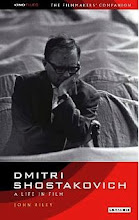
Publications include "Dmitri Shostakovich: a Life in Film" (IB Tauris) and "Discover Film Music" (Naxos, 2008).
I regularly front "I'm Ready for My Close-Up", Resonance 104.4FM's film show.
I wrote, directed and produced the evening-long show "Shostakovich - My Life at the Movies" for the South Bank Centre. It was premiered by the CBSO with Simon Russell Beale and was then produced at the Komische Oper, Berlin, with Ulrich Matthes.