Wednesday, 21 January 2009

Air and Simple Gifts

Perhaps odd, on the day following such a momentous event, to focus on five minutes of minority interest, but we all bring our own perspectives to things and focusing on a detail needn't exclude an appreciation of the bigger picture.

John Williams, apart from being Spielberg's house composer and spending thirteen years heading up the Boston Pops, has written various pieces of what would be called "occasional music", such as four Olympic overtures, the Liberty Fanfare for the Statue's centenary, not to mention various concertos, etc.

So it was natural that his phone should ring when a piece was needed for Obama's inauguration yesterday.

Which brings us to Air and Simple Gifts (the title omits to mention a brief coda).


Williams' decision to write a set of variations on the quaker song Simple Gifts is understandable: it's a popular tune with a 'classical' pedigree (best known as the finale of Appalachian Spring, by Aaron Copland, one of Obama's favourite composers). Classical music isn't normally a part of the ceremony but the Yale Concert Band was to usher Dwight Eisenhower into office in 1953 with a performance of Copland's Lincoln Portrait, before Republican representative Fred E Busbey (ironically from Illinois) complained about the gig being given to a commie

I think it's probably straining things to try to see some significance in the decision to give it to the same, slightly odd ensemble Messiaen chose for the Quartet for the End of Time

There's often a lot of talk about how film scores are now the only way that many people get to hear orchestral (read: classical) music. Williams might not have pushed the boat out in terms of the forces involved (apart from the stellar casting). Nevertheless, it's nice to think that one aspect of a great day was that a million people got to hear the piece live, and goodness known how many on TV and the web. 

Meanwhile BBC viewers were treated to Huw Edwards introducing "four of the most gifted musicians in the world" before proceeding to a pointless conversation with Matt Frei, who described how, in 1841, President William Henry Harrison gave the longest ever inaugural speech before catching pneumonia and dying ("which", Frei reassured the doubtless alarmed audience, "is not going to happen this time round"). Harrison actually lasted just about a month, thus becoming the holder of the shortest ever presidency. So perfectly timed was Frei and Edwards' annihilation of the Air - they finished just before the 'tune' came in - you could imagine it was planned to save us the horrors of having to listen to the first two minutes of a five-minute piece.

Friday, 9 January 2009

Frost/Nixon

I saw Frost/Nixon for the second time the other day (first in the LFF then, on DVD, during a transatlantic holiday) and liked it both times. Of course, in certain circles one isn’t supposed to say that sort of thing because it’s a Ron Howard film but he’s solid enough, though he tends to be at the mercy of his writers: he can’t save A Beautiful Mind but neither can he destroy Frost/Nixon – especially as Sheen and Langella had, through the stage show, essentially been in rehearsal for months. This isn’t the blog for an extensive review (nobody would expect one and I’ve got other things on the burner) but one thing did strike me about Michael Sheen’s portrayal of Frost.

Up to this point Sheen was probably best known for playing Tony Blair in The Deal and The Queen, though his cast of real-life people also includes Kenneth Williams, and he’ll soon be essaying Brian Clough. Incidentally, The Deal's implication that John Smith's chosen successor was Brown and Blair was a usurper put me in mind of how Lenin's will was ignored, but I doubt we'll be seeing Sheen play Stalin any time soon.

In the meantime Sheen found that Frost and Blair share a strangely similar quality: the struggle between a steely will and a child-like desire to be liked.

That’s part of Frost/Nixon’s arc: the superficial playboy chat-show host faces a panward-heading career and possible bankruptcy as no-one wants the interviews that have swallowed a good chunk of his own and his friends’ money. But he pulls himself together and sits up all night doing the research to nail Tricky Dick, saving the day and forging himself a new reputation.

Similarly, Steve Bell famously skewered the young Blair as Bambi, whose radical agenda (if it was ever there) was immediately dropped for fear of scaring the voters. But a few years later the sight of a million people marching down Whitehall did nothing to change his mind. Steve Bell’s description of him as having one angry eye and one smiley one seems to sum that up.


For Blair/Sheen the decisive moment was the death of Princess Diana but for me – and I don’t think this was simply an inability by either Sheen or me to shake off the earlier role - in Frost/Nixon there were definitely some moments featuring a strange chimera: Blast or (more likely) Flair.

Friday, 5 December 2008

Synch Sound

Settling into NFT3 for the Out of Sight Out of Sync event, I read Takahira Iimura's programme note. It wasn’t promising.

Using the system of academy leader: 10 to 1, the film replaces the number to white space with bip sound (clear leader) gradually until it reaches complete white.

Could it be that simple? When the film started, my heart sank – yes it could. It seemed we were in for the filmic equivalent of strict process music or total serialism. The creator makes a set of decisions and then sets it all in train like a line of tumbling dominoes. But not so entertaining.

Of course the artist's abdication of ongoing control can lead to embarrassments like the unintentional chord of A minor that turns up in the middle of one of Stockhausen’s Klavierstücke. Oh, how we laughed at the irony…

But for me, once the system is understood, it rather negates the actual experience. The apex is possibly James Tenney’s unlistenable August Harp in which the unfortunate soloist (and listener) endure 43 grinding minutes, arpeggiating at an unchanging trudge through every possible permutation of a diatonic tetrachord, altered by use of the pedals (I’ll save you the effort: there are – count ‘em – 81). An all too representative sample is here. Tenney’s own exertions were somewhat milder as he simply wrote the instructions on the back of a post card, doubtless driving the benighted recipient literally ‘postal’.

Anyway, back to the darkened NFT. It seemed that we’d be subjected to the same sort of artistic waterboarding: the visual count down – 10, 9 (+ 1 white), 8(+2 white)… etc all the way to 1(+ 9 white) and then back up to 10 accompanied only by the intermittent blip and the hiss and pop of the track.

I confess I quickly did some mental arithmetic. Thank God, only 200 seconds.

But then – wasn’t there a missing number? An eye-slip or a knackered print? But the moment had gone. Slowly, other ‘anomalies’ appeared and the sequence began increasingly to short circuit and loop back on itself. So we went from 8 to 4 or from 3 to 7, and the sense of 10-1 being a irreducible series was paradoxically intensified and weakened as it was first broken and then reconstructed. In our heads invisible strings linked the new, artificial series, the criss-crossing creating an elegant mental cat’s cradle.

A dreaded 200 seconds mysteriously became an enchanting twelve minutes. Iimura's underselling the film.

Thursday, 27 November 2008

Veljo Tormis

Veljo Tormis: Works for Men’s Voices

Toccata Classics. TOCC0073


The Soviet regime was always wary of nationalist feelings in the republics but, for Estonians, music was a buttress against Russification and Sovietisation. In the four years before gaining independence in 1991 more than a fifth of the population would regularly join the so-called Singing Revolution (laulev revolutsioon), defiantly congregating in the streets to perform forbidden songs.

By then Veljo Tormis had been composing for over thirty years, concentrating on choral music and creating monumental cycles as well as smaller one-off songs.

Tormis was born in 1930, the eldest son of a farmer who was musically active in the local church in Vigala, Estonia, At 12 he entered Tallinn Conservatory but two years later the Soviets arrived and stopped the too-religiously-inflected organ class, so Tormis transferred to choral conducting, though the lack of churches restricted opportunities there as well. In 1951 he moved to Moscow to study with Vissarion Shebalin – to whom no doubt I’ll return – graduating in 1956.

The Soviets attitude to the Republics was always ambivalent: on one hand encouraging nationalism but at the same time taking care that it should not grow too strong. Tormis’ interest in Estonian folk music had been supported by Shebalin and, supporting himself by teaching in Tallinn, he went on to study the music of Orff and, after a visit to Hungary in 1962, Kodaly.

This climaxed with his first great cycle, Estonian Calendar Songs (Eesti kalendrilaulud) for mixed chorus (1967) and by 1969 was able to support himself, composing film scores, an opera and, overwhelmingly, choral music. Estonian national identity is closely bound to its choral traditions – amateur singing is endemic - hence Tormis’ importance and popularity.

Tormis himself said it best in setting the exiled Gustav Suits’ poem I’d Like to Sing a Song (Ühte laulu tahaks laulda)

I’d like to sing a song,
Just this only one:
That would rise a huge wave of sea
From the heart

You can hear (and buy) it here.

Titles like Bridges of Song (Laulusild) and Forgotten Peoples (Unustad rahvad) imply attempts to bind together misbegotten populations through music. The latter (formed of six sub-cycles) is particularly poignant as an epic memorial to endangered civilisations, such as the Izhorians and Votes. The Soviets responded by banning some of his works.

Tormis develops ancient Estonian regilaul, ‘runic’ songs, which might include imitations of natural sounds and something close to rhythmic speaking or shouting, with proto-minimalist rhythms. But Tormis avoids pared down Pärt-ishness: his musical roots are less religious than folk-pagan and very specifically Baltic-Finno-Ugrian: “It is not I who makes use of folk music: it is folk music that makes use of me.” As well as settings of modern Estonian poets, there are spells and incantations from the Finnish national epic, the Kalevala, and the Estonian equivalent, the Kalevipoeg.

Tormis creates a vast range of colours and textures and a huge dynamic range: the epic Curse Upon Iron (Ruaa needmine) is the highlight of the disc, running the gamut from whispering to shouting, by way of uncanny choral glissandos. You’ll have to turn up the volume for the quiet bits, but prepare to be blasted out of your chair a few minutes later. The Bishop and the Pagan (Piispa ja pakana) sets chant-like sections against, freer, more irregular music to tell both sides of the story of a 12th-century British missionary martyr. Beside these 10-minute mini-epics are catchy, witty and thrilling little pieces like An Aboriginal Song (Pärimaalase lauluke) and Incantation for a Stormy Sea (Incantatio maris aestuosi).

Tormis’ music is simultaneously ancient and newly minted, and the Svanholm Singers under Sofia Söderberg Eberhard hurl themselves into it with fantastic gusto. Tormis himself joins in, playing the shaman drum in two songs and the anvil in another, while counter-tenor Stefan Engström also does a turn on log drums. Along with some whistling, these sounds make the disc even more atmospheric.

Tormis isn’t a new name (for those in the know) but, though there have been several CDs of his music, he isn’t as widely known as his compatriot Pärt. Toccata Classics’ excellent selection, including premieres of a couple of revised pieces, is a welcome push in that direction.

Fans of choral music, and anyone with a taste for Kodaly, Orff (the insistent Musica Poetica from his Schulwerk was used in Malick’s film Badlands) or Bartók’s Mikrokosmos shouldn’t wait.

Friday, 21 November 2008

Shameless self promotion

Just in time for Christmas, I thought I'd point to a few things that I've been up to (relatively) recently.

A heads-up on the arrival of my book Discover Film Music from Naxos. It comes with two 78-minute plus CDs, with examples of everything from Steiner's King Kong (1933) to ... errr .... Ifukube's Godzilla. Actually there's a disc of Hollywood music from the aforementioned ape to Spider-Man, and another covering composers from or working in Britain, Sweden, the USSR, Italy, Switzerland, France, Japan, Belgium and Poland. Not the whole of the rest of the world, I realise, but there was a word-count! Finally, there's a timeline (highlighting selected Oscar-winners and literary adaptations with notable scores) and a glossary. There's a description on the Naxos site and you can buy it from all the usual outlets. If you need any more persuading, there's a review here though you might have to scroll down a bit to get to it.

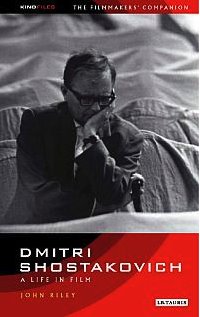
I should also point out a few other recent arrivals, all Shostakovich-related. A couple of (quite different) round ups of his cinema career that I've written appear in two symposia.

With 640 pages, Michael Mishra's A Shostakovich Companion from Praeger Publishers should keep everyone who has a sturdy enough bedside table entertained for a good while. There's a full description and a list of contents here. In brief, the first half is taken up by Michael's look at how Shostakovich's music was received through and after his life (thankfully, a section not hijacked by Testimony discussions), and an analytical biography. Then there's a series of essays (including a return appearance from the editor!) analysing aspects of selected works. Approaches range from the musicological (his passacaglias) to the more literary (his dramatic impulse seen through the two operas). Finally a trio of articles look at his pianism, his legacy as seen through his students, both official and unofficial, and, courtesy of yours truly, his cinema work.

With a cover price of £95 it might be something that you'd want in your Christmas stocking (though one kindly soul is selling a second-hand copy on Amazon for only £94.99!) Whilst the cover might not be as striking as some others, I've included it simply because I've done it for everyone else and I'm nothing if not fair.

If you're harder pressed (and happy to take a shorter essay from me - though who would want to do that?) you could shell out about half as much for Pauline Fairclough and David Fanning's Cambridge Companion to Shostakovich (details here). Where the analyses in Mishra's book often look in great detail at particular works, this takes in entire genres (though with chapters on the First Symphony and the Second Piano Sonata). It begins with musicological workouts for the symphonies and string quartets before wandering further afield. The ballet, film and theatre music is set in the context of Shostakovich's life and the political turmoil in which he was unfortunate enough to live. This approach has the advantage of including some usually overlooked pieces, like The Song of the Forests, a work better than its 'inspiration' (Stalin's reforestation scheme) might imply.

Just to reassure everyone that my contributions to these two books are different, and different again from my full-length book. Indeed, if I ever got the chance to do a second edition, I'd definitely include some of my subsequent observations from these essays as well as my ongoing research.

Finally, a more specific essay Keeping the Icons on the Wall: Shostakovich's Cinema and Concert Music appears in the trilingual (English, Russian and Italian) Dmitrij D. Šostakovic (1906-1975). Tra musica, letteratura e cinema (there's also a pdf with a little more info). I look at some of the revolutionary songs and other pieces that Shostakovich quoted in various works and see how their repetitiveness, in conjunction with the films' cinematic style, could echo the effect of religious icons, enhancing the propaganda while turning music critics off. This book's a bit harder to track down, but you can buy it direct from the publishers Leo Olschki and there's also a list of overseas sellers on the site.

Sadly, I don't get any extra money should you decide to indulge in these tomes (and I selflessly urge you to do so), but I do get a nice warm glow from knowing that I've satisfied you!

Saturday, 25 October 2008

Korean Film Festival

The Korean Film Festival at the Barbican looks promising, if only on the strength of the two films that I've already seen.

Kim Ji-Woon's The Good, the Bad, the Weird (Joh-un nom, nappun nom, isanghan nom) is a massively enjoyable mash-up of Leone (the title, credit sequence and train-bound opening scene are explicit nods), Kurosawa and Hong Kong wire-work with some bizarre comedy thrown in. The market gunfight with the diving helmet (you have to see it) is hilarious, while the climactic single-handed decimation of the Japanese army as they gallop through the Manchurian desert is weirdly life-affirming in its pure energising enthusiasm. The delirious, almost relentless alternation of chase-fight-chase-fight hardly lets up and the 139 minutes fly by as quickly and as enjoyably as any Keaton film. There are a few nods to 1930s Sino-Japanese relations but if you're looking for a history lesson, this isn't it.

There are a couple of screenings at the London Film Festival but the Barbican has managed to persuade the director along to do a post-film screen-talk.


Utterly different is Lee Chang-dong's Secret Sunshine (Milyang). The quiet story of a woman struggling to start a new life after the death of her husband is utterly gripping and filled with tiny but resonating signs of her recovery. Jeon Do-yeon is on screen practically constantly and deservedly won Cannes' best actress award. 

Wednesday, 22 October 2008

The Silence Before Bach

A quick heads up for a great film in the LFF: The Silence Before Bach (Die Stille vor Bach). Sadly, as so often with the avant-garde stuff in the fest it is allegedly sold out (a single show on Thurs 23 Oct at 4pm in NFT2) but if you're in the area it's definitely worth dropping in to see if there's a chance of getting in. Information here.

I'll be writing more on it in due course.